Before the Modern Idea of Privacy
Before the modern idea of privacy, rooms and customs shaped who could withdraw, keep a confidence, or control access. Learn how to read those boundaries.
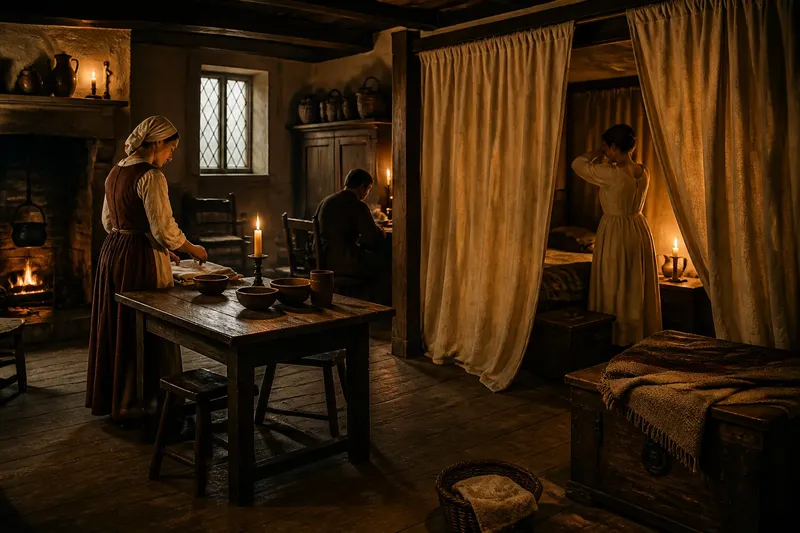
The most common mistake in the history of privacy is to treat a shared room as proof that its occupants had no boundaries. That shortcut can erase the ways people used curtains, customs, and rank to regulate access. In accounts of English households from the late medieval and early modern periods, for example, rooms often served several purposes, while seclusion depended on who could claim a space and who was expected to yield.
Why does privacy look older than it is?
People in many places and periods sought solitude, guarded confidences, and limited what others could see. A person might close a door, whisper a message, cover a possession, or ask a visitor to leave. These acts show that people recognized boundaries. They do not, by themselves, establish a shared expectation that each person should have a personal zone of seclusion.
The distinction is between a practice and an organizing idea. Privacy in a modern sense can mean a recognized claim to withdraw from observation or control access to one’s body, thoughts, correspondence, and home. Historical rules about access often reflected rank, kinship, gender, occupation, or religious duty rather than an equal individual entitlement. The balance differed across societies and periods, so a broad contrast should not be mistaken for a universal chronology.
To interpret a boundary, ask what it did. Did it protect a household’s reputation, mark a sacred area, shield a valuable object, or give someone time alone? The same closed door could serve different purposes. No single act reveals an entire society’s understanding of privacy.
Why does a floor plan tell only part of the story?
A household might use the same room for sleeping, work, meals, and conversation. Beds could stand behind curtains or screens; a chest might be locked; a chamber might be reserved for someone with authority. These arrangements created distinctions without providing a separate room for every resident.
A shared room did not necessarily mean that everyone could see or approach one another at all times. A curtain could limit sight, a screen could redirect attention, and a customary rule could discourage entry. Such devices did not create soundproof solitude, but they could shape who was expected to look, listen, or approach.
The reverse mistake is to treat a separate chamber as proof that everyone enjoyed personal seclusion. A room’s use depended on who controlled it and who had permission to enter. A household head might have a room for business or rest while servants and younger relatives worked or slept in shared spaces. The building offered possibilities; social authority shaped who could use them.
What does a room reveal about household rank?
Room names can mislead when read through present-day assumptions. In some historical descriptions, “private” distinguished a room from public business without meaning that it belonged to one person alone. A bedroom might host visitors, household work, or family conversation as well as sleep.
Ask who used the room, when, and under whose authority. Inventories, plans, and descriptions can suggest where objects and activities belonged, but they rarely settle every question. A lock may have secured money or documents rather than a person’s right to be undisturbed. A curtain may have divided a bed from the rest of a room while leaving conversation audible.
This distinction helps separate privacy from privilege. If one resident could withdraw because others were expected to serve, wait, or leave, that person’s seclusion rested on status. It did not necessarily express a shared rule that every household member deserved comparable control over access.
How did social customs create boundaries without walls?
Etiquette could require a knock, limit visiting, or distinguish what could be discussed in company from what belonged within a family. Religious customs might reserve particular spaces or moments for specific purposes. Rules of hospitality could welcome guests while limiting where they went and whom they addressed.
These conventions could matter even when a house had few doors. People learned to turn away, lower their voices, or avoid questions considered improper. A boundary existed because others recognized it, not only because a wall made crossing it difficult. Customs could also be enforced unevenly: a person with authority might ignore a limit that a servant, child, or dependent relative was expected to respect.
Say a household in an invented historical setting shares one main room, but its residents treat a curtained sleeping corner as off-limits during dressing. The curtain blocks the view, and a household rule tells others to wait. The expected observable result is a short interval of bodily privacy without a separate bedroom; the arrangement still does not give every resident equal power to claim the space.
Why did ideas of privacy change unevenly?
There is no single turning point that explains the history of privacy across all places and groups. To keep the claim precise, consider households in England from the late medieval into the early modern period: room arrangements and expectations about access changed over time, but they did not change in lockstep. Building practices, household organization, work, and social expectations all affected how people could withdraw.
More distinct rooms could make seclusion easier, but a room’s availability still depended on money, status, age, gender, and household needs. Expectations about correspondence, personal conduct, or conversation could also shift without every home gaining a room for solitude. Conversely, a household could have separate chambers while maintaining close supervision.
Different groups experienced different forms of access at the same time. A merchant’s household, a laboring family, a religious community, and a courtly household might organize space and presence in sharply different ways. The useful question is not simply whether a period had privacy, but what kind, for whom, and under which rules.
What questions help interpret historical privacy?
Did people have privacy if they shared a room?
They could have partial privacy through screens, curtains, timing, or rules about attention. Shared space limited some forms of seclusion, but it did not erase every boundary.
Does a lock prove that a room was personal?
A lock shows that access could be controlled, not who held the right to control it or why. It may have protected valuables, records, or household authority rather than an individual’s personal life.
Were earlier households simply less private?
That broad comparison hides differences in what people sought to keep separate. Bodily, social, or informational boundaries could matter even where personal rooms were scarce.
When did the modern idea of privacy emerge?
There is no single date that fits every place and group. For English households, it is more careful to describe gradual changes in domestic arrangements and expectations than to name one origin point.
How can you read claims about privacy with care?
When a historical account says a household had “little privacy,” identify what the phrase means in that passage. It may refer to crowded sleeping arrangements, limited control over visitors, audible conversation, or a lack of rooms reserved for individual use. These conditions are related, but they are not interchangeable.
- Check the place and period named: If the account identifies both, keep your conclusion within that scope; if it does not, avoid treating the claim as universal and look for a more specific account.
- Check whether the evidence is a floor plan: If it shows doors and rooms, use it to describe layout; if you need to know how people behaved, seek descriptions of customs or room use.
- Check who controlled the room: If authority rested with one household member, describe the seclusion as unequal; if control is unclear, state that the evidence does not identify who could refuse entry.
- Check what a lock protected: If records or valuables are named, describe their security rather than personal privacy; if the purpose is unknown, do not infer it from the lock alone.
- Check whether a curtain or screen limited sight or sound: If it blocked sight but not conversation, describe visual separation only; if the evidence does not say, avoid claiming either effect.
- Check whose experience the source records: If it describes a household head, do not generalize to servants or children; if other residents are absent, seek evidence about their access before making a household-wide claim.
Imagine a reader encounters an invented account of an English household with a shared sleeping room, a locked chest, and a curtained bed. First, the reader notes that the account identifies the place but not a precise date, so avoids attaching it to a specific historical turning point. Next, the reader treats the room description as evidence of shared space, the chest lock as evidence of controlled access to an object, and the curtain as evidence of a visual boundary only if the account says it blocked sight. Finally, because the account does not identify who could close the curtain or refuse entry, the reader describes partial separation but leaves individual control unresolved. The result is a narrower claim that fits the evidence rather than a verdict that the household had either privacy or none.
Evidence of practice matters as much as layout. Descriptions of visiting, household rules, objects, and room use can show how people managed access. A plan can indicate where a door stood; by itself, it cannot tell you whether knocking was expected or whether a resident could refuse entry.
In the history of privacy, keep the distribution of control in view. Ask whose seclusion was protected and whose presence was treated as available to others. A careful account of a home notices not only where its walls stood, but who could ask another person to stop at the threshold.